
I have always enjoyed learning about other cultures. As a history major at Colorado State, I was drawn to learning through reading firsthand accounts. Having resided in North Macedonia for over a year, I have had the privilege to listen to the life stories of my host family and others in the community. Each person has a distinct and interesting story to tell. Through a series of biographies, I hope to share their stories and shed light on the diverse histories and cultures of the people in this country. This is the biography of my Host Grandfather, Lazar. As I began writing this blog, I realized starting this series with Lazar might have been a mistake as Lazar’s life is so fascinating and complex that a short blog can only scratch the surface.

Lazar was born in 1939 in an Eastern village of the Osogovo Mountains. At the time, this area was part of the Kingdom of Serbia. It is now part of North Macedonia. He grew up in a large family with three brothers and four sisters. All eight children and his parents lived in a two-room house without electricity. Lazar’s parents were farmers and focused primarily on livestock, including pigs, goats, and sheep. The only means of transportation between villages was on horseback. When not doing chores, his siblings and friends played many games, mainly football (soccer), with a ball made entirely of socks. Other childhood games sounded familiar, like playing hot/cold – an object would be hidden somewhere, and one person plays, receiving hot/cold hints from the others until the object was found. Other games were unfamiliar – like his favorite game, which involved digging a hole and placing a stick with the plate on top of it. Whoever could scoop the plate off the ground and send it the farthest would win. I still struggle to understand this game. When it warms up, I plan to ask Lazar to show me how to play it.
At the age of eleven, Lazar left his family to live in a larger village near Kochani, where he lived at the school to further his education. In 1955, at the age of sixteen, Lazar moved to Bitola, a significant city in modern-day North Macedonia, to attend Veterinary High School. In 1955, Macedonia was part of the Socialist Federal Republic of Yugoslavia, which was formed after World War II and led by Tito as a communist country. Lazar’s academic path was determined by government officials who made decisions based on students’ grades. Due to his high scores in Chemistry and Biology, Lazar was sent to Bitola. A village sponsorship facilitated his living expenses, contingent on his return to work for four years after completing his education. After graduating from the Veterinary School at 21, Lazar went to Zagreb, Croatia, one of the largest cities in former Yugoslavia, to further his studies.
Once his studies were completed in Zagreb, he returned to fulfill his contractual obligation in the village, where he worked for four years while also attending school in Belgrade, Serbia, the capital of Yugoslavia. During this time, Lazar, at age 22, was called to serve his mandatory eighteen-month-long service in the Yugoslavian army. Young men were required to serve a year and a half in the military but could extend their service or become a reservist. For eighteen months, Lazar trained to be a Reservist officer in the Yugoslavian army. His training was based out of Mostar (Bosnia-Herzegovina). While Lazar never saw direct conflict, he was called back twice to work for one month. At 36, he was mobilized and worked as a veterinarian for over one hundred and fifty horses. The second time, he had been advanced to the rank of Reservist Captain and assisted in training others in veterinarian care.
After completing his training, Lazar continued living in a village outside of Kochani (North Macedonia), where he practiced veterinarian medicine for forty years. He cared for all types of livestock (horses, pigs, goats, sheep, cows, etc.) and dogs/cats. While he had a small Veterinary Hospital in the village, he often traveled from home to home to care for different animals.
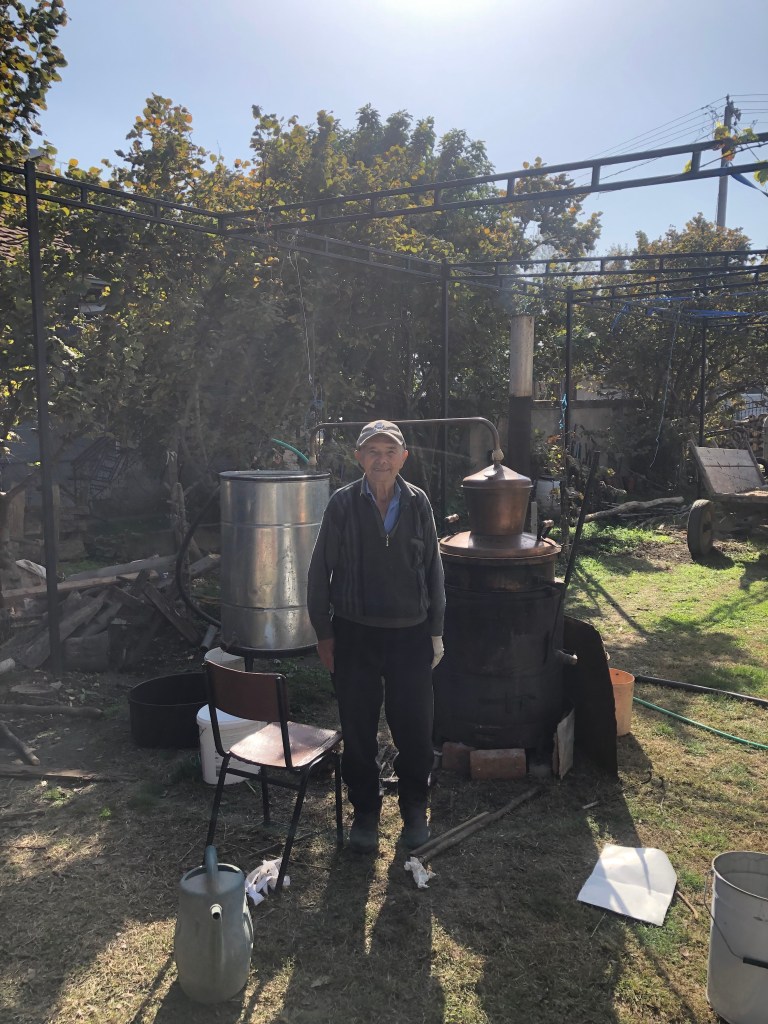
Lazar married Blagica in 1959 and had two children. Blagica passed away in 1996. Lazar continued his career as a veterinarian until retiring at age 62. Lazar lives with his son and wife in the same house where he raised his family. Throughout his life, Lazar had always held a fond interest in gardening, farming, history, and distilling rakija. On a warm day, he can always be found out in the garden or sitting in the sun with one of the many neighborhood cats in his lap.
The Socialist Republic of Yugoslavia lasted from 1945 to 1992 when it broke into six different countries. Throughout his life and while living in what are now three different countries, Lazar believes the best times were when Northern Macedonia was part of Yugoslavia. He believes Yugoslavia was on par with America. He said: “Yugoslavia was independent, we weren’t connected with only America or Russia. It was free. Everyone had food, houses, manufacturing, a strong economy, and vacations – all workers, whether industrial workers or doctors. Moreover, Yugoslavia had international hiking clubs so people could go to the Alps and other choices within the country’s borders or Europe. People worldwide could engage with Yugoslavians through the hiking club.” Lazar took part in this hiking club and was fortunate to travel across Europe and hike.
One of Lazar’s strongest memories relates to the disaster that struck Skopje (the capital of North Macedonia) in 1963. A 6.1 magnitude earthquake killed more than one thousand people, injuring thousands more and leaving over two hundred thousand people homeless. Lazar said half of the city was destroyed. He went to Skopje shortly after the earthquake and saw the city devastated. The mafia and other illegal groups ran the city during these challenging times when the city was without electricity and other essential services. For the month he was there, he had a police officer walk with him because robbing and crime were at a peak. During this section of the interview, Lazar became nostalgic and sad because of the tough times this nation and its people went through. He sees similarities in pictures of present-day Gaza. Destruction was everywhere, and the rule of law had disappeared.
Lazar believes important life lessons are:
· “Surrounding yourself with good people and good friends is important.”
· “Do what you plan to do (i.e., buy a house or a car) and not brag.”
In our village, Lazar is still known as “Lazar the Veterinarian” for his incredible work and how he benefited the community. He was the first veterinarian in the area, and everyone I have encountered thinks highly of his skills and how he lived his life and raised his family.

I have truly enjoyed getting to know Lazar. He is a remarkable person and has been kind to me during my stay.

 To MAK and Back
Leave a reply to Sue Cancel reply